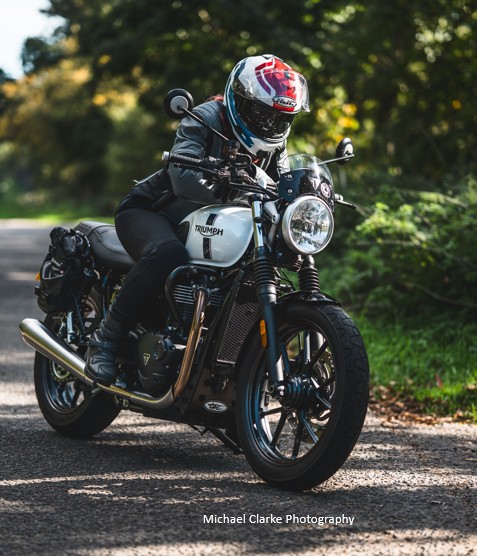
Karen Rhodes explains how MotoKind became a place where riders come before motorcycles.
Karen Rhodes did not set out to build a major motorcycle community. But through MotoKind, she has created a trusted space where riders connect through kindness, belonging and genuine human connection — and in doing so, has reshaped what online motorcycling community can look like.
Karen Rhodes before MotoKind
Sometimes, when you spend time talking to someone, you realise that what they're building today is simply another chapter in a story they've been writing for years.
Before Karen Rhodes ever thought about motorcycles, she and her husband had fostered more than twenty children. She had supported veterans' families, built successful businesses and earned recognition as an entrepreneur, and there is a thread running quietly through it all.
Connection. Not networking. Not marketing. Not simply bringing people into the same room. Genuine human connection.
It is a philosophy she sums up in a single sentence.
"Connection isn't transactional – it's transformational."
Long before MotoKind existed, that belief was already shaping the way she lived her life. Motorcycling simply gave it a new home.
How Karen started riding
If anyone had told Karen a few years ago that she would become a motorcyclist herself, she would have laughed.
For more than twenty years she had happily ridden pillion behind her husband, Bill. Riding was something they enjoyed together, but always from the same familiar position. She had no particular desire to take the handlebars herself.
Like many women reaching midlife, though, she found herself quietly questioning what came next.
Writing recently about that period in her life, she described feeling as though perimenopause had shrunk her world. She wrote that "middle age has a sneaky way of making women disappear." It is a sentence that will resonate with many women, not because they have all experienced it in the same way, but because so many recognise that subtle feeling of becoming less visible, less adventurous, or somehow expected to settle into a quieter version of themselves.
Then one evening, sitting in a pub, she watched a group of bikers arrive.
One rider climbed off her motorcycle, removed her helmet and shook out her hair.
She wasn't twenty years old. She wasn't the image Karen had unconsciously carried in her mind. She was about Karen's age.
"She looked cool as **," Karen laughed. "I'm going to do that."
"I'll pay for your lessons and buy your first bike," her husband replied.
It was exactly the push she needed.
Karen admits she expected learning to ride to be easier.
After all, she'd spent two decades watching her husband ride. She knew what motorcycling looked like. Surely it couldn't be that difficult?
Instead, she found herself completely overwhelmed.
The clutch. The gears. The throttle. Trying to think about all of them at once while surrounded by teenagers who seemed to pick everything up naturally.
Eventually, her instructors made a decision that bruised her pride but transformed her progress. They put her on a scooter.
"I was mortified," she admitted. "I was the only woman there. I was the oldest there. Everyone else was on big bikes and I was pottering around on a scooter." Looking back now, she laughs about it.
The instructors had recognised something she couldn't yet see herself. Once the complication of clutch control disappeared, she relaxed, found her road sense and built confidence one step at a time.
Soon afterwards she climbed straight from a 50cc scooter onto a restricted MT-07.
"There was no pressure," she smiled. "I just rode it."
Three months after starting, she completed her DAS and waiting at home was her Triumph Street Twin 900.
What motorcycling gave her
Just two weeks after passing her test Karen joined around 46,000 riders at Dave Day.
"I stalled going into the car park," she laughed. "I looked at Bill and said, 'You park it!'"
It was hardly the confident entrance she'd imagined, but perhaps that's exactly the point. Every experienced rider has moments like these. They simply don't all admit them.
Today, Karen rides whenever she can.
The shopping.
A coffee.
A weekend away.
A European tour.
She now owns two motorcycles and already has plans to develop her off-road skills before eventually tackling adventures further afield.
When I asked what gets her out onto two wheels, her answer surprised me.
"It's the only time my brain is quiet," she said.
"My husband says my brain is like a box of broken biscuits. It's going a hundred miles an hour all the time. Then I put my helmet on and whatever needs to be released will be released."
That feeling of stillness perhaps explains why riding became so much more than another hobby for so many people.
Why Karen created MotoKind
Riding had given Karen something she hadn't expected. It wasn't simply a new hobby or a different way to travel. It introduced her to a community unlike any she'd experienced before.
Like many people outside motorcycling, she'd grown up with the familiar stereotypes. Loud bikes. Leather jackets. A world that could seem intimidating from the outside. The reality, she quickly discovered, couldn't have been more different.
As she traveled further, visited more bike nights and spent time with riders from every walk of life, she found herself continually impressed by the generosity she witnessed. Charity rides raising thousands of pounds. Riders volunteering to escort funerals and proms. Complete strangers stopping to help someone broken down at the roadside. Time and again she saw people giving up their weekends simply to help somebody else.
When I mentioned that many non-riders still struggle to see that side of the community, Karen smiled. She had recently been looking at a venue for future MotoKind workshops when the owner asked whether bikers would arrive "revving their engines."
Karen explained about the charity rides, fundraising events and the countless small acts of kindness that rarely make the headlines.
"She said, 'I didn't realise bikers did that.' Well... there you go."
The more immersed she became, the more convinced she was that the motorcycling community deserved a better reputation than it often received.
Yet, at the same time, she couldn't ignore something else she was noticing. When Karen first immersed herself in the biking world, she expected to find one big motorcycle community.
Instead, she found dozens.
Sports bike riders.
Adventure riders.
Classic enthusiasts.
Cruiser owners.
Women's groups.
Brand groups.
Training groups.
Every one of them built around a shared passion, yet often existing alongside one another rather than together.
It wasn't something she criticised. Karen understands why people naturally gravitate towards riders with similar interests. Most hobbies work that way.
But over time she began to notice a contradiction.
The divisions she saw online rarely existed in the same way when people met face to face.
Sit riders around the same café table and the labels quickly faded into the background. The Triumph rider was chatting to the Harley owner. The sports bike rider was admiring the adventure bike loaded with camping gear. Conversations moved effortlessly from motorcycles to travel, work, families and life. The warmth she experienced at bike nights, charity rides and cafés didn't resemble some of the debates she occasionally saw online. Different bikes became conversation starters rather than dividing lines.
The motorcycles had brought everyone together.
The friendships had very little to do with what they rode.
It made Karen question whether the problem was ever really motorcycling or whether it was simply the way people interacted online.
That realisation stayed with her and eventually, it became the seed from which MotoKind grew. That thought became MotoKind.
What is Motokind and what makes it different?
Karen laughs now when she remembers what she originally intended to create.
"It was just going to be a Facebook group that I could hang out in."
Nothing more, no grand strategy or business plan. No expectation that thousands of riders would eventually join.
Karen told me that when she joins an online community herself, she almost never posts immediately, she watches and reads, quietly working out whether it feels like somewhere she belongs. If it doesn't, she leaves.
"I created it because I couldn't find a space that I felt safe in," she explained.
That single sentence explains almost every decision that followed.
Motokind's 'about' section neatly summarises it's purpose: A place for riders who want connection without noise, belonging without pressure, and kindness without ego.
That kindness isn't accidental. Kindness is an active decision. Karen moderates for it. She expects businesses to demonstrate it if they post on the site and the Motokind community to respect it.
MotoKind's moderation isn't about preventing disagreement. It isn't about creating an artificially cheerful corner of Facebook where everyone always agrees. It is however about protecting something much more important, Trust.
"Trust takes a long time to build," she wrote, "and I understand how quickly it can be lost."
Karen knows how easily one dismissive comment can silence somebody who has finally found the confidence to ask a question. She also knows how difficult that confidence can be to rebuild.
We talked about what guides moderation on MotoKind:
"The first thing is, 'Is it kind?' Does it add value to the conversation?" she told me. "We don't want someone thinking, 'This feels a bit prickly. I don't know if I can post here.'"
This approach is working for the MotoKind community. People who once posted anonymously gradually begin using their own names. Members who spent months simply reading conversations eventually introduce themselves.
Connection - MotoKind Beyond Facebook
What becomes clear after spending time with Karen is that MotoKind has never really been about Facebook. Facebook simply happens to be where people first meet, where friendships develop.
"I don't want people sat behind keyboards," she said simply. "I want them meeting each other."
Those friendships are forming, with members of the group arranging their own meet ups and ride-outs triggered by connections in the group.
MotoKind has evolved beyond the FaceBook group and has become an ecosystem still built around the community, across other formats.
Karen hosts events that help riders build confidence and capability, she’s currently planning ‘Know Your Bike’ workshops , not because everyone should become a mechanic, but because understanding your bike makes you feel less intimidated and more informed.
There are a number of rider resources building, based upon the industry collaboration and community knowledge and experience. Businesses are paying attention to what riders are talking about. Industry conversations are increasingly being shaped by the questions, experiences and perspectives that ordinary riders share every day.
Karen's philosophy shapes the way MotoKind engages with businesses. She isn’t looking for businesses that simply want to advertise, rather, they need to become part of the MotoKind community because she believes that’s how trust is built.
Following the recent news surrounding SuperBike Factory, Karen invited members to recommend dealerships they'd had great experiences with. What surprised her wasn't which businesses were mentioned, but why.
Again and again, riders spoke about being listened to, remembered and treated with respect. Very few talked about price, they talked about people.
"The people I remember are the ones who join in the conversations, share their knowledge and genuinely want to help."
She talks about introducing riders to local businesses that care about their customers. During our conversation she spoke warmly about independent training schools, cafés, organisers and small motorcycle businesses that quietly support riders every day. Those are the people she wants to champion. Not because they have the biggest advertising budget, but because they have earned the respect of the community through the way they show up.
"One of the reasons MotoKind has grown," she wrote, "is because we've been careful about protecting what makes it special. Riders aren't treated like a marketing list, and the community isn't a place where businesses can simply turn up and advertise."
Karen's place in the WomenOn2Wheels Support Crew
As our conversation came to an end, I found myself thinking back to the woman Karen saw climbing off her motorcycle outside that pub a few years ago.
She could never have known that, by simply taking off her helmet, she would inspire another woman to change the direction of her life. Karen often says that one person can make a difference. Her own story suggests she is right, a woman inspired her to learn to ride.
MotoKind is now inspiring thousands of other riders to find friendship, confidence and a place where they feel they belong.
That's the legacy Karen hopes to leave.
Not simply a successful motorcycle community, but proof that kindness, trust and genuine human connection still have the power to bring people together.
If you enjoyed this article please do check out the rest of the www.womenon2wheels.co.uk site for rider stories, gear reviews, training, maintenance, travel & more