
A dry or neglected chain wears quickly and can affect how the bike feels on the road.
What to Check
Check: Is it clear of grit and lubricated? Is it rusty? Does it appear excessively loose?
If your chain looks dirty
Even after a dry ride your chain will be getting dirty - old lubricant will become sticky and dust and grit will adhere. In wet weather sticky mud and surface grit will be flung up onto your chain.

If Your Chain Looks Rusty
A light orange coating on the outside of the chain is quite common, especially if the bike has been ridden in the rain or washed and not dried properly.

What to do:
As a general rule: Lubricate every 300-600 miles and after riding in heavy rain and after washing the bike. A chain should look lightly lubricated, not dripping in oil.
Put the bike on a paddock stand if you have one. If not you'll need to move it mid clean to access all of the chain.
Spray the chain with a dedicated chain cleaner.
Use a chain cleaner and chain brush to gently remove dirt and rust.
Wipe clean with a cloth.
Apply fresh chain lubricant being careful to avoid your tyres, you can hold some cardboard between your chain and tyre.
Leave it to soak in before riding.

Essential kit:
We'd recommend that you invest in a chain cleaner and a chain brush so you can remove old sticky fluid and grit when washing your bike, and you will needa motorbike specific chain lubricant.
Brush for Chain & Sprockets Muc-Off Claw brush
Chain Cleaner: Muc-Off Drivetrain cleaner
Popular chain lubricants include Oxford Mint All Weather Lube, S100
Muc-Off wet weather chain lube or Muc-Off Dry Weather chain lube
If Your Chain is Too Tight or Loose
Checking your chain tension is one of the simplest and most important maintenance jobs you can do on your motorcycle. It's right up there with checking your tyre pressures and oil level, and only takes a few minutes.
A chain that is too loose can slap around, make excessive noise and, in extreme cases, come off the sprockets. A chain that is too tight can wear out the chain and sprockets more quickly and may even affect how well your rear suspension works.
How much chain slack should my bike have?
Every bike has a recommended amount of chain slack, usually around 30–40mm on many road bikes, but it's always worth checking your owner's manual for the correct figure.
This is a great question to ask after a service as it will be at the correct tension at that point, but also ask what would be considered too loose or too tight for your bike.
To check the tension, find the section of chain midway between the front and rear sprockets. Push the chain up, then pull it down, and measure the total movement. If it's outside the manufacturer's recommended range, it may need adjusting.
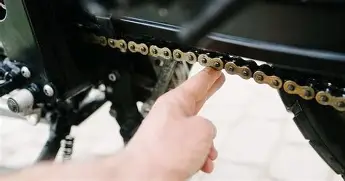
OK, so adjusting the chain is a bigger task, but with the right tools, and fortified by a cup of tea, and with the help of a good YouTube video (see below) we promise its fine, and once you've mastered this you have an important tick in the box to your biking independence.
Adjusting the chain involves loosening the rear wheel axle and moving the wheel slightly forwards or backwards using the adjusters on each side of the swingarm. It's important to make equal adjustments on both sides so the rear wheel remains correctly aligned.
Once adjusted, tighten everything to the correct settings, recheck the chain slack, and finish by cleaning and lubricating the chain.
It might sound intimidating the first time, but checking your chain is one of the easiest maintenance skills to learn. A few minutes every couple of weeks can help your bike run more smoothly, improve safety and extend the life of expensive components.
We recommend MC Garage's excellent YouTube tutorial
Essential kit:
When it comes to motorcycles, you almost certainly need a 1/2in drive torque wrench, to adjust your chain.
A torque wrench is one of the most frequently used and most important tools you can get. In a nutshell, it’s a ratchet-like device with an adjustable clutch that stops turning the nut/bolt when a predetermined torque figure has been reached. This prevents nut and bolt threads from being over-stretched or breaking off.
To use it, you add the relevant socket to the 1/2in square drive (like any other ratchet), set the torque rating on the marked handle, and tighten the nut or bolt in question. Once the right torque is reached, there’s an audible ‘click’ and the tension goes slack.
Draper 1/2" Square Drive Ratchet Torque Wrench or Silverline Torque Wrench
You'll need a 1/2 inch socket set, ideally an impact set as these are rated for motorcycle wheel nuts, suspension bolts, and other high-torque applications.
Ginour Impact Socket Set 1/2 Inch, 17PCs
Next, a good set of spanners is also a garage essential.
Spanners are used when there’s no room to fit a socket. Combination spanners – open-ended one end and a ring spanner (like a flat socket) on the other – are the best bet. This is a helpful addition to your toolkit as it’s often necessary to hold a bolt as you undo the nut.