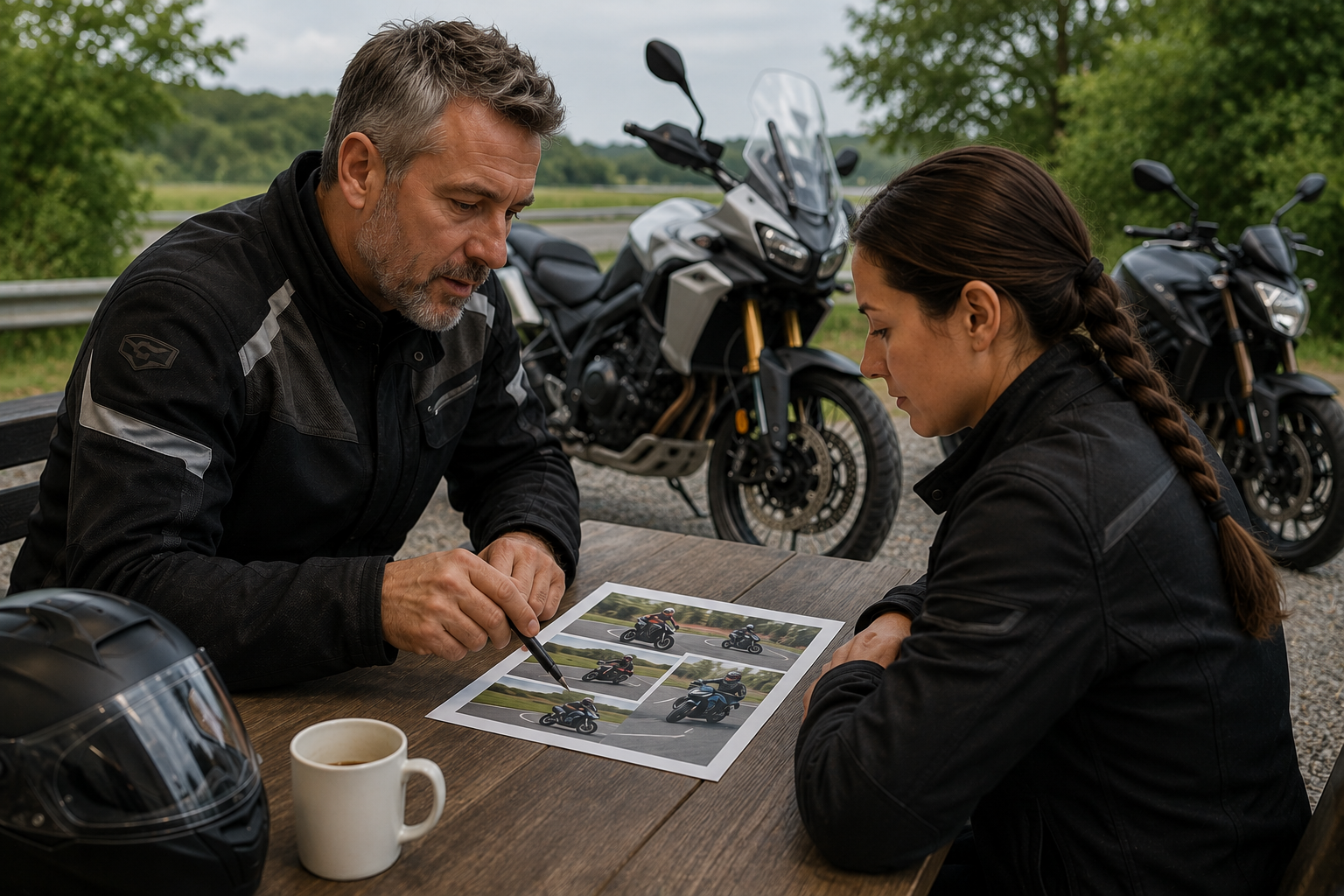
The DVSA Enhanced Rider Scheme
The DVSA Enhanced Rider Scheme is a professional post-test coaching route for motorcyclists who want to improve confidence, control and roadcraft. Learn what ERS involves, who it suits, the pros and cons, and what to expect on the day.
What is the DVSA Enhanced Rider Scheme
The DVSA Enhanced Rider Scheme (ERS) is a voluntary post-test coaching programme for motorcyclists who already hold a full motorcycle licence.
The scheme is designed for riders who have recently passed their test, are returning to motorcycling after a break, are moving to a more powerful bike, or simply want an independent assessment of their riding. Rather than teaching riders from scratch, ERS aims to build on existing skills through tailored professional coaching, helping riders become safer, smoother and more confident on the road.
The DVSA does not describe ERS as an "advanced riding qualification." It describes it as a scheme that checks your riding skills and provides training to help you improve, resulting in a DVSA Certificate of Competence. Effectively ERS is structured post-test coaching against a nationally recognised DVSA standard.
That may sound like semantics, but this distinction is a key difference between ERS and IAM RoadSmart or RoSPA advanced test.
Pros and Cons
Why ERS might be right for you
Personalised coaching
Perhaps ERS's greatest strength is that it isn't a one-size-fits-all course. The coaching is usually bespoke, aimed squarely at your weak points. Two riders can leave with completely different experiences because the training is based on their individual needs rather than a rigid syllabus.
Many women tell us they don't lack the ability to ride—they lack confidence in certain situations. Whether it's overtaking, reading fast bends, riding unfamiliar roads or simply worrying about "getting it wrong", the psychological side of riding can sometimes become a bigger barrier than the technical skills themselves.
That's why the targeted coaching-based approach of ERS has real value. Instead of asking, "Can I pass a test?", it encourages riders to ask, "What would help me feel more confident on the road?"
ERS involves having an experienced instructor ride with you, identify one or two key areas for improvement and give you the confidence to put those techniques into practice.
Professional feedback
One of the biggest differences between ERS and organisations such as IAM RoadSmart or RoSPA isn't necessarily what you learn—it's how the coaching is delivered.
ERS is delivered by a DVSA-approved professional instructor. You're paying for a service, much like you would if you booked an advanced driving lesson or specialist motorcycle tuition. The relationship is straightforward: the instructor assesses your riding, coaches you in the areas that need improvement, and once you've reached the required standard, your training is complete.
IAM RoadSmart and RoSPA take a different approach. Most coaching is provided by trained volunteer observers or tutors who generously give up their own time to help riders develop before an advanced test. Many riders value the ongoing mentoring and sense of community this creates, while others can feel a degree of obligation to fit around someone else's availability or to continue attending group rides and meetings as part of the club environment.
Neither approach is inherently better—they simply suit different riders. If you're looking for structured professional coaching that starts and finishes on your timetable, ERS may appeal. If you're looking for longer-term mentoring and becoming part of an advanced riding community, IAM RoadSmart or RoSPA may be a better fit.
No formal riding test
Another key difference with ERS is that there is no big end-of-course test hanging over you, because assessment happens continuously throughout the training.
If improvements are identified, your trainer will develop a personalised coaching plan focused on those specific areas. The amount of additional training varies from rider to rider, with some completing the scheme after a single day's assessment and others returning for further coaching.
Once the trainer is satisfied that you're consistently demonstrating the required standard, you'll be awarded your DVSA Certificate of Competence. For many riders, particularly those who lose confidence under test conditions, this can make the experience feel far less intimidating. Rather than focusing on passing or failing on a particular day, the emphasis is on developing your riding until both you and your instructor are confident you've reached the required standard.
That's not to say ERS is an easier option—it still requires riders to demonstrate safe, competent riding—but it recognises that people don't always perform at their best when they feel they're being examined.
Or why ERS it might not be the right path.
It won't make you an advanced rider overnight
This is perhaps the biggest misconception.
The initial assessment ride may show that you're already riding to the required ERS standard. In those cases, you may complete the scheme during your first day.
For many riders, however, the assessment identifies areas for improvement, followed by one or more additional coaching sessions before the instructor is satisfied you've consistently demonstrated the required standard.
The number of days isn't the goal. Developing safer, smoother riding is.
Some riders can complete ERS in a single day because they already ride to the required standard. Others need two or three sessions before demonstrating the necessary skills.
But completing the scheme shouldn't be confused with mastering advanced riding.
Learning a new technique is one thing. Turning that technique into an instinctive habit that you apply on every ride takes practice, experience and time.
Choosing the right instructor matters
One of the biggest factors in any coaching experience isn't the syllabus—it's the person delivering it.
ERS is often completed over one or two days, so you'll spend a significant amount of time with a single instructor. Their teaching style, communication and personality can have a huge influence on how much you enjoy the experience and how much confidence you gain from it.
Unlike organisations such as IAM RoadSmart or RoSPA, where relationships often develop over weeks or months with volunteer observers and local groups, ERS is usually a much shorter, more intensive experience. That means there's less time to build rapport or discover whether your learning styles naturally suit each other.
Before booking, it's worth taking the time to research your trainer. Read reviews, ask about their coaching style and don't be afraid to ask questions. Finding an instructor who makes you feel comfortable, listened to and supported can be just as important as the qualification itself.
We created the Training Hub because finding the right instructor shouldn't be a matter of luck. Alongside information about the courses each school offers, we're building a community of rider feedback so women can make more informed decisions based on other riders' experiences at that provider.
If you've completed ERS, we'd love to hear about your experience. Your feedback on your training provider could help another rider find the instructor who's right for them.
Less opportunity for ongoing peer support
Because ERS is a standalone coaching scheme, it doesn't automatically connect you with an ongoing riding community.
That's worth considering because organisations such as IAM RoadSmart and RoSPA offer more than advanced training. Their local groups provide regular ride-outs, talks and social events, allowing riders to continue learning alongside experienced motorcyclists who share a common focus on safe, progressive riding.
For many riders, particularly those looking to build confidence, that supportive network can become one of the greatest benefits of membership. Riding regularly with experienced, encouraging people provides opportunities to observe different techniques, ask questions and continue developing long after the initial training has finished.
If you're someone who learns best through regular practice and the support of a like-minded community, that's something ERS doesn't naturally provide.
What to expect on a DVSA ERS day
Before you ride
Most ERS assessments don't begin by jumping straight onto the bike.
Your trainer will usually spend 15–30 minutes discussing:
your riding experience
what you use your bike for
any previous advanced training
what you want to achieve
any areas where you feel less confident
This conversation helps shape both the assessment and any subsequent coaching. The DVSA syllabus specifically encourages trainers to understand the rider's expectations and concerns before heading out.
The assessment ride
You'll have an initial assessed ride for the trainer to identify areas to focus on. The aim is simply to see you riding naturally in different situations rather than trying to catch you out. Throughout the ride you'll normally be in radio communication with your instructor.
Don't feel you need to ride perfectly. The purpose of the assessment isn't to prove you're an advanced rider—it's to give your instructor an honest picture of your current riding so they can coach you effectively. Trying to "ride for the assessment" rather than riding naturally may actually make it harder for your instructor to identify the areas where they can help most.
During the assessment, a DVSA-approved trainer observes your riding across a range of road and traffic conditions, looking at seven core areas including planning, hazard awareness, use of speed, overtaking, cornering, slow-speed control and rider attitude.
The initial assessment ride usually lasts between one and two hours, which the DVSA considers sufficient to assess most riders across a variety of road and traffic conditions.
The Debrief
After the ride you'll sit down with your instructor to discuss:
what went well
areas for improvement
whether you've already met the required standard
or what further coaching would benefit you
Many riders say this feedback session is where the real learning begins, as it helps explain not just what to improve, but why.
If improvements are identified, your trainer will develop a personalised coaching plan focused on those specific areas. The amount of additional training varies from rider to rider, with some completing the scheme after a single day's assessment and others returning for further coaching before demonstrating the required standard.
If the trainer is satisfied that you're already riding to the required ERS standard, you'll receive a DVSA Certificate of Competence without needing any further training.
Women On 2 Wheels Community Feedback
The Positives
"It identified habits I didn't know I had"
We all develop habits over time. One of ERS's greatest strengths is having a professional pair of eyes identify the ones you no longer notice yourself.
This is probably the most common positive comment we heard.
Riders talk about instructors spotting "fossilised errors"—little habits that have crept into their riding over years and become normal. Others said experienced instructors quickly identified their weak points and focused on the underlying causes rather than just correcting symptoms.
"It was enjoyable, not intimidating"
Quite a few riders expected a stern assessment but instead described the day as enjoyable, relaxed, constructive and fun. All said there was plenty of time for discussiom, and the coaching aspect consistently comes through more strongly than the assessment aspect.
"It made me a safer, smoother rider"
When we asked about outcomes very few responses related to the certification, instead the women we spoke to talked about the improved skills they felt they left with, the most common were smoother riding, looking further ahead and generally better observation and planning, and greater confidence.
Several riders even said they'd happily repeat ERS every couple of years as a riding "health check."
The instructor makes all the difference
Nearly every positive review praises the instructor personally, People mention ex-police riders, approachable personalities, constructive feedback especially that they received good explanations on why techniques work
"I tried IAM, I didn't like my observer and felt awkward changing"
A few of our respondents said they appreciated the more business like approach, and had struggled with the volunteer observer model, turning to ERS as a better fit for them
The criticisms
"It's expensive, especially compared with a BikeSafe day"
Quite a few riders questioned the cost / value for money
Not because the coaching wasn't worthwhile, but because:
insurance savings are often very small
some providers charged our respondents £300–£400
Once the core scheme has been completed, riders can also choose from a range of optional specialist modules covering topics such as advanced braking, motorway riding, carrying a pillion, group riding, riding abroad and motorcycle maintenance. While all valuable it can become expensive, and these are often subsidised through IAM clubs
Several comments suggest choosing ERS for the coaching—not because you expect it to pay for itself.
"Over time I felt I slipped back into old habits"
Quite a few respondents compared ERS with IAM because once ERS finishes that's it. The lack of ongoing observed rides, club rides, talks, mentoring, social events mean there aren#t opportunities for continued development.
"I took ERS to attain an advanced rider qualification, but its not given the same recognition"
"I don't feel like an advanced rider"
"I keep having to explain what ERS is"
This is the interesting one.
Some forum members told us they get comments questioning whether completing ERS after a single assessment day could really be equivalent to passing IAM or RoSPA after weeks or months of observed rides and a formal test. Others that the ERS is less well known, and doesn't yet have the same standing.
It's less an argument about ERS itself and more a debate about what different qualifications represent.
Our Verdict: Is DVSA ERS worth it?
The DVSA Enhanced Rider Scheme occupies a unique place in rider development.
Rather than offering a structured programme for every rider, it starts with a simple question: what would make you a safer, more confident rider? From there, the coaching is built around your individual needs, allowing you to focus on the skills that will make the greatest difference to your everyday riding.
For riders who value professional one-to-one coaching, appreciate flexibility and prefer learning through development rather than examination, ERS has a great deal to offer. Being coached by a DVSA-approved instructor means you're receiving personalised feedback from someone whose day job is helping riders improve.
ERS won't be the right choice for everyone. Some riders will prefer the ongoing mentoring, community and advanced test offered by organisations such as IAM RoadSmart or RoSPA. Others will simply want an expert assessment of their riding, targeted coaching and the confidence to enjoy every journey a little more.
Ultimately, rider development isn't about collecting qualifications—it's about continuing to learn. If ERS helps you ride more smoothly, make better decisions and feel more confident every time you get on your bike, then it has done exactly what it was designed to do.
Still not sure whether ERS is right for you? Read about alternative training options:
Have a look at the WomenOn2Wheels Training Hub for ERS training providers in your area, or use the recommender on the Hub to find somewhere that best suits what you are looking for., helping connect you with women instructors, lowered bikes or providers that come with our reader community recommendations.