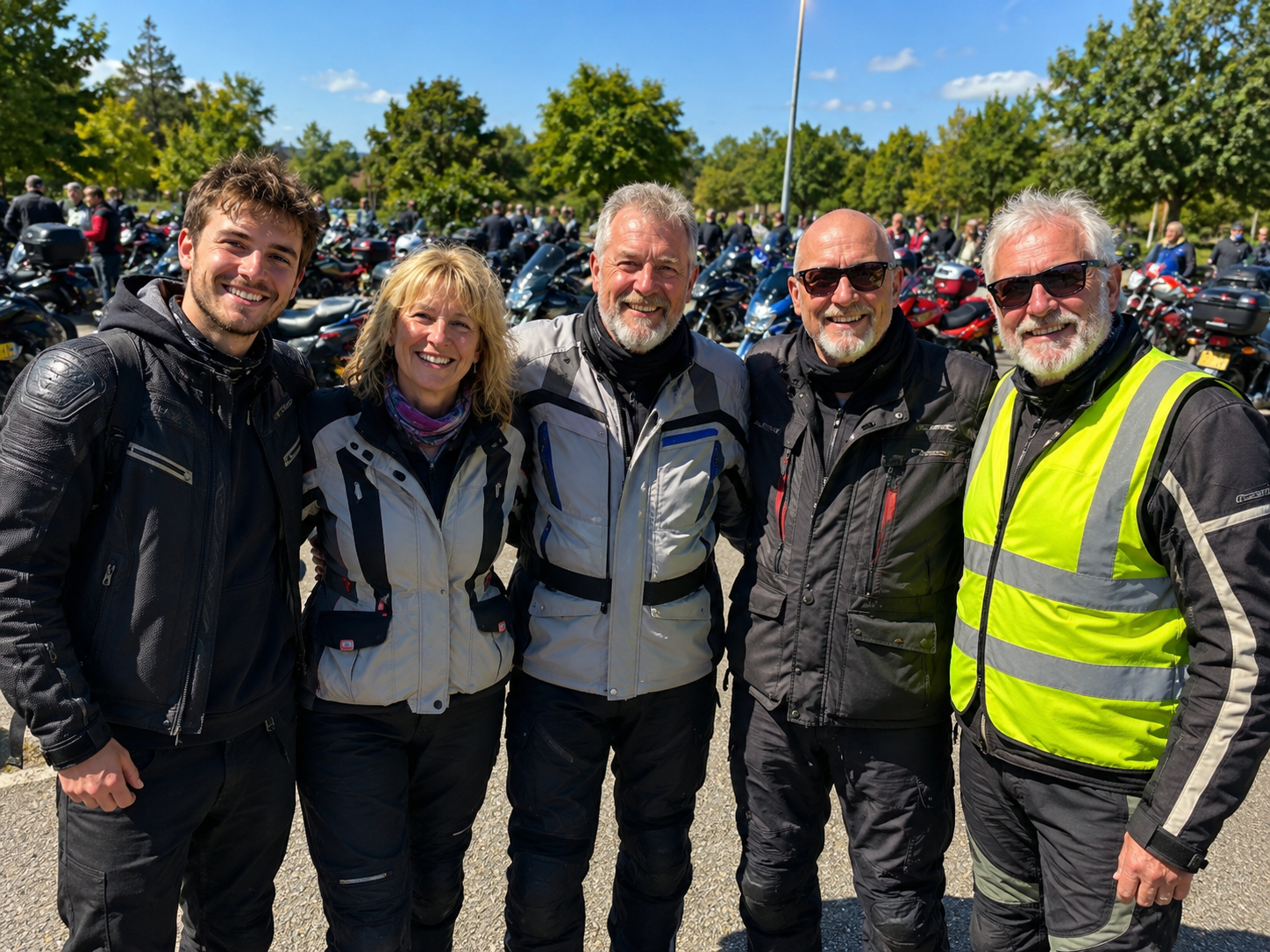
Whether you have been riding for six months or twenty years, there is always room to improve your observation, planning and confidence on the road. That is exactly why advanced rider training appeals to so many motorcyclists across the UK. One of the best-known names in that space is IAM RoadSmart.
Few organisations in British motorcycling divide opinion quite like IAM RoadSmart.
Ask one rider and they'll tell you it transformed the way they ride. Ask another and they'll describe it as overly structured, old-fashioned or "full of old blokes telling you what you're doing wrong."
Over the past few weeks we've spoken to IAM members, former members and riders who've chosen different advanced training routes, as well as drawing on our own experience as members. What emerged wasn't a simple answer, but a picture of an organisation whose greatest strength—and sometimes its greatest challenge—is that no two IAM experiences are quite the same.
What is IAM RoadSmart?
Founded in 1956, IAM RoadSmart is the UK’s largest road safety charity.
Its Advanced Rider programme is based on the police Roadcraft system, a structured approach to observation, planning and machine control designed to help riders make safer, smoother and more progressive decisions on the road.
The foundation of IAM RoadSmart training is the police Roadcraft system—a methodical approach to riding that has been developed and refined over decades.
The best-known example is the System of Motorcycle Control, often referred to simply as IPSGA.
IPSGA stands for:
Information – What can you see? What can't you see? What are other road users doing? What hazards are developing?
Position – Where should you place the motorcycle to maximise safety, visibility and stability?
Speed – Select an appropriate speed for the hazard ahead before reaching it.
Gear – Choose the gear that best suits the speed and road conditions.
Acceleration – Accelerate smoothly when it is safe to do so, maintaining stability and making progress.
The important point is that these aren't five separate techniques. They form a continuous sequence that advanced riders repeat almost subconsciously throughout every ride.
As one Observer explained:
"IPSGA isn't about memorising five words. It's about giving your brain a process to follow until good decisions become instinctive."
Roadcraft also introduces a number of other structured concepts that gradually become part of your everyday riding.
These include maintaining effective observation links, planning well ahead, identifying developing hazards early, making progress without compromising safety and ensuring every action has a clear purpose rather than becoming a habit.
Many riders describe this as the moment their riding begins to change. Rather than reacting to hazards as they appear, they find themselves reading the road much further ahead and making decisions earlier, leaving more time and space to deal with the unexpected.
Who is IAM RoadSmart for?
One misconception we encountered repeatedly was that IAM is only for riders who already consider themselves "advanced."
In reality, members join for all sorts of reasons.
Some have recently passed their test and want to build confidence before tackling bigger tours. Others have ridden for decades but feel they've slipped into bad habits. Some simply enjoy learning and see advanced training as another stage in their riding journey.
Several members told us they'd delayed joining because they assumed they "wouldn't be good enough." Ironically, many later wished they'd joined much sooner.
The Journey from Associate to Observer
One aspect of IAM RoadSmart that often goes unnoticed is the amount of experience and training behind the volunteers who support associate members.
Although Observers generously give up their own time, they aren't simply experienced riders who volunteer to accompany others. Becoming an Observer is a progression in its own right, requiring additional training, mentoring and assessment.
Associate Member
Ifvyou choose to join the IAM, you will begin as an Associate and will receive the RoadSmart handbook and a training log. Each Associate is assigned a volunteer observer who provides your training.
Observed rides are scheduled between you, to fit around yours and the Observers other commitments, and when your observer believes you are test ready you are allocated a different observer who will provide a second opinion to validate. Only then will you proceed to the test.
How long this stage lasts varies from rider to rider. Some progress quickly, while others prefer to take more time before they're ready for the test. who will work with you for as many months as are needed to prepare you for your test. This is often nearer 12 than 6 months, but everyone is different.
Full Member
Passing the Advanced Rider test makes you a Full Member of IAM RoadSmart.
For many riders, this isn't the end of the journey. Members often continue attending ride-outs, talks and social events, using the group as an opportunity to keep developing their riding and learning from others.
Many experienced members describe the Advanced Rider test not as a finish line, but as the point where they truly begin understanding advanced riding.
Observer
Some members choose to take the next step by becoming an Observer.
This involves far more than simply accompanying another rider. Prospective Observers undertake additional training to develop coaching, communication and mentoring skills, learning how to assess a rider's strengths, identify areas for improvement and provide constructive, personalised feedback.
Rather than demonstrating how they would ride, an effective Observer helps another rider understand why particular techniques are recommended and encourages them to develop their own judgement and decision-making.
Only after successfully completing this additional training are they authorised to mentor Associates working towards their Advanced Rider qualification.
National Observer
Many groups also have National Observers.
These are highly experienced Observers who have demonstrated an even higher standard of coaching and riding. They often mentor newer Observers, support quality assurance within their local group and may work with riders who have more complex development needs.
Their role helps ensure that Associates receive consistent, high-quality coaching while maintaining the standards expected across IAM RoadSmart.
Examiners
The final Advanced Rider test is conducted by an IAM Examiner.
Examiners are independent of the local group and are appointed by IAM RoadSmart to assess whether an Associate has reached the required advanced riding standard. Their role is not to coach during the assessment, but to make an impartial judgement against nationally recognised criteria.
Because the Examiner has had no involvement in the rider's training, the assessment provides an independent confirmation that the required standard has been achieved.
What to expect from an Observed Ride
Before you need to make the financial commitment to join you can book a free taster session. You'll be assigned what is referred to at my local IAM as a 'fluffy', in my group these are the avuncular, warm newbie friendly ambassadors of the observer team. They will take you for a ride of around an hour which will give you insight into the observed ride experience, and the feedback which follows.
When you meet your eventual assigned observer you'll already have your feedback sheet from your taster ride.
Your assigned Observer will want to discuss your riding, asking about your experience, what type of riding you enjoy and anything you'd particularly like to improve.
The ride itself typically covers a variety of road types and traffic conditions, allowing your Observer to assess your observation, planning, positioning, speed, cornering, overtaking and hazard awareness.
Afterwards you'll receive detailed feedback explaining both your strengths and the areas where further development would benefit you. As your skills improve, the rides become less about identifying faults and more about refining your riding until you're consistently demonstrating the advanced standard expected for the final test.
What are the benefits of joining the IAM?
A structured approach to riding
Roadcraft provides a systematic framework for reading the road, planning ahead and making safe, progressive decisions. It teaches a repeatable decision-making framework.
Rather than teaching a collection of individual riding techniques, Roadcraft encourages riders to adopt a consistent decision-making process that can be applied to almost every situation on the road.
This systematic and repetitive learning over time is a very effective way to instill and embed skills throughly.
Ongoing development
One of IAM's greatest strengths is the opportunity to spend time with riders who have often accumulated decades of experience.
Whether discussing cornering, touring, machine control or simply sharing stories over coffee after a ride, many members say this informal learning is just as valuable as the formal training.
Unlike many training courses, learning doesn't have to stop once you've passed the Advanced Rider test. IAM isn't simply a course you book and complete.
Many members continue attending ride-outs, talks and observed rides for years afterwards, with some choosing to become Observers themselves.
Value for Money
Considering the hours that go into the observed rides, the access to experienced members, and that the Membership includes the preparation for the Advanced Rider test and the test fee itself, it isa particularly cost effective route to your advanced accreditation.
We mentioned the controversy...things to consider
The experience varies between groups
When you join, you're joining a local group of riders. The training, mentoring and much of the social side are delivered by volunteers who give up their own time because they enjoy helping other motorcyclists improve. That regional model is one of IAM's biggest strengths—but it's also one of the reasons experiences vary so much.
If possible, go along to a social evening, meet the members and get a feel for the group before committing. If it doesn't feel like the right fit, don't assume every IAM group is the same—another nearby group may offer a completely different experience.
Although the organisation sets the training standards nationally, the atmosphere, personalities and activities can differ considerably from one group to another.
One may organise weekly ride-outs, café evenings and guest speakers, while another focuses primarily on observed rides and advanced test preparation.
Some groups have waiting lists for Observers. Others can get you riding almost immediately.
Some have an active mix of ages, riding styles and backgrounds. Others remain smaller and more traditional.
One rider summed it up perfectly:
"People don't join IAM. They join their local group."
It's probably the most important thing any prospective member should know.
The experience varies between observers
You may find that your learning style means you don't gel with your assigned observer, and if so you should feel able to find an alternative but that may be an uncomfortable experience for some.
It can also be frustrating dealing with the idiosyncracies between different observers. Their volunteer status and the wider social politics of the group puts you less in control of the experience.
It's based on a structured riding system
Roadcraft is one of the most respected motorcycle riding systems in the world, but it is also highly structured.
Many riders appreciate the consistency this brings, but others prefer a less systematic coaching style. Much depends on how your Observer explains the principles and adapts them to your riding.
It requires a time commitment
IAM isn't designed as a one-day course, completing the programme may take several weeks or months depending on your progress and local group.
You need to be flexible but committed, observed rides are arranged around the availability of both you and your Observer, so some compromise may be required. Your observer may not share your outlook on riding in inclement weather for example.
What do riders say?
Spend an evening reading motorcycle forums and you'll quickly discover that almost everyone has an opinion about IAM RoadSmart. Some have been members for decades, others completed the course years ago, and many have never joined but still have strong views.
What stood out to us wasn't the occasional extreme opinion—it was the themes that appeared time and again.
Many riders told us they wished they'd joined sooner.
"I thought advanced riding was for people who'd been riding for 30 years. I wish I'd realised it was actually for people who wanted to keep improving."
Again and again, riders described becoming smoother rather than faster.
"I don't ride any slower than before—I just feel like I'm working a lot less hard."
Observation was another recurring theme.
"The biggest thing it changed wasn't my bike control. It was how far ahead I was looking and how much earlier I was making decisions."
For many members, however, the qualification wasn't the thing they talked about most. It was the people.
"I joined for the advanced test. I stayed because of the ride-outs."
"Every ride feels like a chance to learn something."
"Nobody ever made me feel stupid for asking questions."
Several members spoke about the confidence that came from riding regularly with experienced motorcyclists.
"You naturally start picking up better habits when you're surrounded by people who think about their riding."
"The Observer taught me a lot, but I learned just as much from chatting over coffee after the ride."
Not every experience was identical.
"Our group is really relaxed and sociable."
"The neighbouring group has a completely different atmosphere."
Several riders encouraged prospective members to visit a local meeting before joining.
"Go along, have a coffee, meet the people. You'll know pretty quickly whether it's your kind of crowd."
The most common criticism centred on coaching style rather than the Roadcraft system itself.
Some riders felt their Observer was excellent at explaining the reasoning behind each technique, while others found the coaching more directive than collaborative.
"A good Observer doesn't tell you what to do—they help you understand why."
The perception that IAM is dominated by older men also surfaced repeatedly. Some riders admitted that walking into their first meeting felt intimidating, particularly if they were younger or one of only a handful of women.
Equally, many women who had joined told us those concerns quickly disappeared.
"I expected to feel out of place. Instead, I was made to feel welcome from the first evening."
Perhaps the most telling comment came from a rider reflecting on their own preconceptions.
"I nearly let the reputation put me off. I'm glad I didn't."
Our verdict
IAM RoadSmart isn't simply an advanced riding course—it's an advanced riding community.
If you're looking for a quick riding assessment or a few hours of targeted coaching, there are other options that may suit you better. However, if you enjoy learning from others, value constructive feedback and like the idea of developing your riding over time alongside experienced motorcyclists, IAM has a great deal to offer.
The Advanced Rider qualification is an excellent achievement, but many members would argue it isn't the most valuable part of joining. The friendships, shared knowledge and opportunities to keep learning long after the test are what make IAM RoadSmart different providing not just the pathway to that goal, but a community to enjoy the journey with.
Still not sure whether IAM is right for you? Read about alternative training options:
DVSA ERS (Enhanced Rider Scheme)
Check out Faith Merrett's article on how IAM made a difference to her and Sparky, the Flying Banana