RoSPA Advanced Riders Explained
Test, Grades, Gold and What Riders Think
RoSPA Advanced Riders is one of the UK’s best-known advanced motorcycle schemes, offering structured coaching, an independent Advanced Test, and graded awards from Bronze to Gold. For many riders, it represents one of the most respected routes to becoming a better, safer and more systematic road rider. For others, it raises fair questions about commitment, grading and whether advanced riding should be something you keep proving over time.
That tension is part of what makes RoSPA so interesting. It is admired, sometimes questioned, and rarely dismissed. Mention it at almost any bike night and someone will have an opinion.
Much of that reputation comes not just from the standard of riding it promotes, but from the philosophy behind it. RoSPA Advanced Riders does not present advanced riding as a one-off box to tick. Instead, it treats it as a standard to work towards, maintain and keep refining.
What is RoSPA Advanced Riders?
RoSPA Advanced Riders forms part of RoADAR — RoSPA Advanced Drivers and Riders — the advanced driving and motorcycling arm of the Royal Society for the Prevention of Accidents.
As one of the UK’s longest-established road safety charities, RoSPA is not simply in the business of helping riders pass an advanced motorcycle test. Its wider aim is to encourage safer riding, stronger judgement and continued learning throughout a rider’s time on the road.
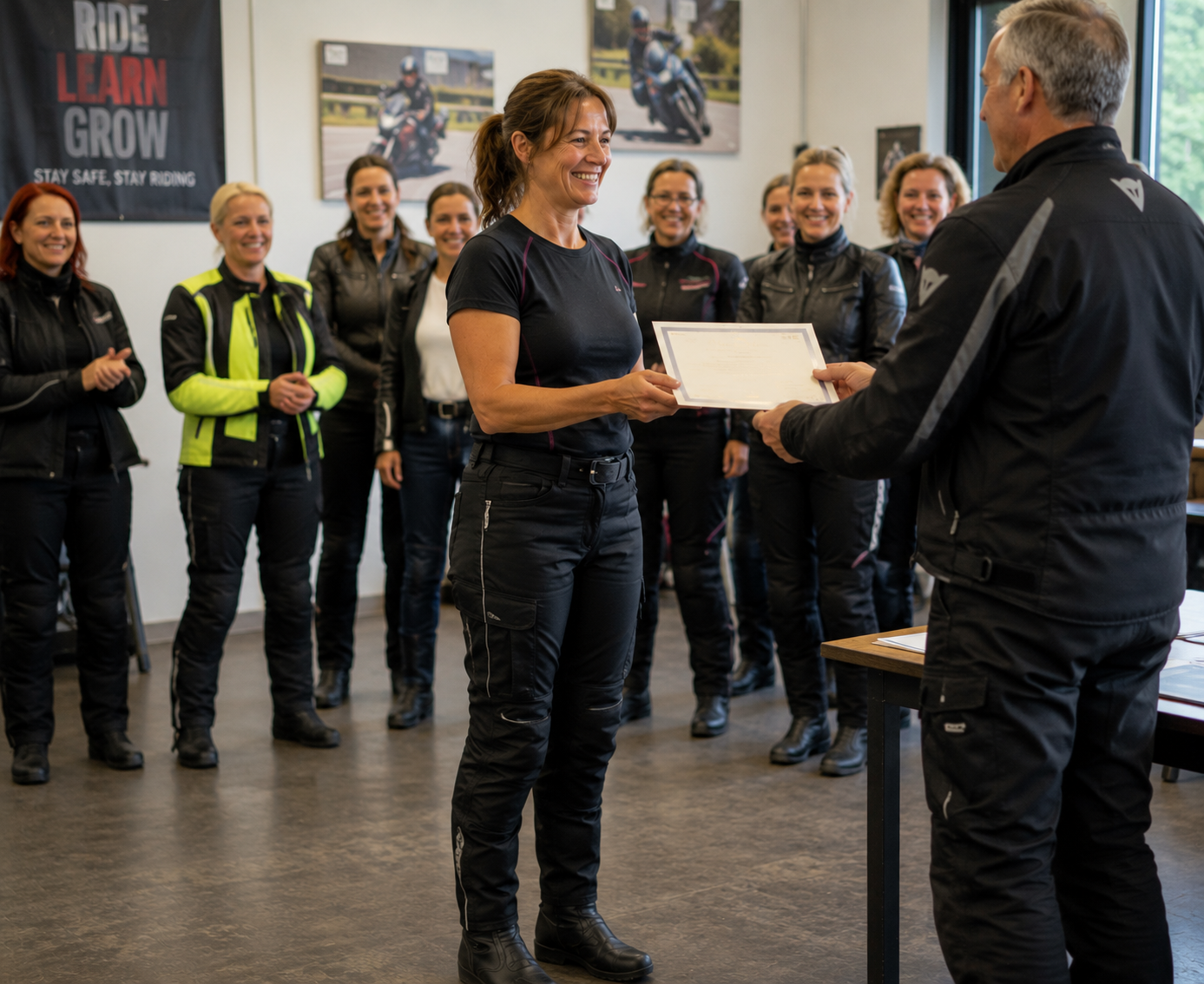
That mindset shapes the scheme from the outset. Unlike a commercial training school, RoSPA delivers its rider training through a network of local volunteer groups across the UK. After joining, riders are usually paired with an experienced Tutor, who guides them through a series of observed rides and helps them prepare for the RoSPA Advanced Test. There is no fixed course length and no rigid timetable. You progress at your own pace until both you and your Tutor believe you are ready.
The training is based on the principles of Motorcycle Roadcraft, the same system of riding used by UK police motorcyclists. The focus is not on flashy techniques or dramatic new bike-handling skills, but on improving the fundamentals that matter most on the road: observation, planning, positioning, cornering, overtaking, hazard perception and decision-making.
At its best, the result is not just faster or more confident riding, but riding that is calmer, smoother and more considered.
How the RoSPA Advanced Test works
When the time comes to take the RoSPA Advanced Test, the final assessment is not carried out by the Tutor who has coached you. Instead, it is conducted by an independent RoSPA Examiner.
That separation between coaching and assessment is a key part of the scheme’s credibility. It helps RoSPA maintain a more consistent national standard, rather than allowing the result to depend too heavily on one group or one Tutor’s preferences.
Unlike some advanced riding schemes, the outcome is not simply pass or fail. Riders who meet the required standard are awarded one of three grades:
Bronze
Silver
Gold
This is important, because while RoSPA Gold gets most of the attention, Gold is only one part of the wider structure. It is the highest grade in the scheme, not the scheme itself. RoSPA Advanced Riders is really about the whole pathway: coaching, assessment, progression and continued development.
Riders who want to improve their grade later can choose to take an Interim Test, rather than waiting for their next scheduled reassessment.
What makes RoSPA different from IAM and ERS?
One of the clearest differences between RoSPA Advanced Riders, IAM RoadSmart and the Enhanced Rider Scheme (ERS) is that RoSPA does not treat advanced riding as a finish line.
If riders want to maintain their qualification, they are expected to retake their Advanced Test every three years. Those reassessments are included within the annual RoADAR membership subscription, and they reflect one of RoSPA’s core beliefs: advanced riding is not simply a skill to acquire, but a standard to maintain.
That principle is central to RoSPA’s reputation. A qualification that still reflects how someone rides now will always feel different from one earned years ago and never revisited.
For many riders, that is exactly why the scheme carries weight.
“It’s not about passing once — it’s about maintaining the standard.”
In a culture where certificates can easily become permanent souvenirs, RoSPA asks riders to keep demonstrating that their standard is still there.
Of course, that same feature can also be the sticking point. Not everyone wants advanced riding to become a long-term commitment. Some riders want a goal, a challenge and a recognised qualification; others are looking for an ongoing framework. RoSPA is much more clearly designed for the second group.
Why riders respect RoSPA
Talk to riders who rate the scheme highly and the same themes come up again and again.
One is that the qualification stays current. Riders like the fact that their grade reflects the quality of their present riding rather than something they achieved years before. In that sense, RoSPA feels less like a trophy and more like a standard that has to be upheld.
Another is the strength of the local group culture. For many members, the local RoSPA group becomes just as valuable as the qualification itself. Regular observed rides, social rides and access to experienced riders can provide encouragement and support long after the test is over. For some, that community becomes one of the strongest reasons to stay involved.
There is also the appeal of structured progression. Bronze, Silver and Gold give riders clear milestones to work towards, while ongoing coaching, Interim Tests and the opportunity to become a Tutor create a sense that the journey does not stop after the first pass. RoSPA can feel less like a short course and more like a long-term riding discipline.
And then there is the simple matter of reputation. Within UK motorcycling circles, RoSPA Gold carries real prestige. Even riders with no intention of pursuing it usually know what it represents. But its status comes precisely from the fact that it sits at the top of a wider scheme that expects standards to be maintained, not just claimed.
As one rider put it,
“Gold only means something because you have to keep earning it.”
The questions riders still raise about RoSPA
For all the respect it commands, RoSPA is not above criticism.
The first question is commitment. For some riders, the idea of ongoing membership and a formal reassessment every three years is exactly what gives the qualification meaning. For others, it feels like more structure than they want. If someone sees advanced riding as a milestone rather than a continuing practice, RoSPA may feel demanding.
There is also the issue of emphasis. Because RoSPA Gold is the highest grade and the one most often talked about, it can sometimes dominate the conversation. Some riders enjoy that challenge and find it motivating. Others feel it creates an unnecessary hierarchy, where discussion drifts away from better riding and towards the status of the badge.
“Sometimes it feels like the conversation becomes more about Gold than about riding.”
Another recurring point is that, while the test standard is national, the rider experience is local. RoSPA depends heavily on volunteer Tutors, which means availability, teaching style and group culture can vary. One local group may be warm, flexible and highly supportive; another may be a less natural fit.
That is not necessarily a flaw so much as a reality of how the scheme works. But it does matter. “The scheme is national, but your experience is local.” Prospective members would be wise to remember that.
Then there is the long-running criticism that advanced riding can become too analytical or too rigid. RoSPA is clearly aware of that perception. Its use of Roadcraft is consistently framed as a system for supporting judgement, not replacing it. The ideal is not robotic riding, but adaptable and informed decision-making.
Many members say that concern is overplayed. They describe Tutors who encourage discussion, flexibility and thoughtful judgement rather than box-ticking. Even so, as with any volunteer-led organisation, styles will vary, and riders who are sensitive to that side of advanced training may benefit from visiting a local group before committing.
Is RoSPA Advanced Riders worth it?
Whether RoSPA Advanced Riders is worth it depends on what a rider wants from advanced training.
If the goal is a respected advanced motorcycle qualification with depth, structure and ongoing accountability, RoSPA remains one of the strongest names in the UK. Its credibility comes from the quality of the coaching, the independence of the assessment and the expectation that standards should be maintained over time.
If, on the other hand, the goal is to reach an advanced level once and then move on, the scheme may feel more involved than necessary. That does not make it better or worse than the alternatives; it simply means it is built around a different philosophy.
That philosophy is what gives RoSPA its distinctive place in British motorcycling. Gold may be the highest level of attainment, but the real story is bigger than Gold alone. The enduring reputation of RoSPA Advanced Riders comes from the scheme as a whole: the training, the grading, the reassessment and the idea that good riding should remain a living standard.
And that is why people still nod when RoSPA comes up. Not because it is fashionable, but because it still stands for something clear: advanced riding as a discipline, not just an achievement.
Still not sure whether RoSPA is right for you? Read about alternative training options: