Passing your test is only the start. Advanced motorcycle training can make you safer, smoother and far more confident on the road — but with options like DVSA ERS, IAM RoadSmart, RoSPA and specialist skills courses, choosing the right route depends on what kind of rider you want to become.
Why advanced motorcycle training is worth your time
Because passing your test is only the beginning — and there is a lot more fun to be had once you stop riding like every bend is out to get you.
Taking your riding to the next level is one of the most rewarding decisions you can make as a motorcyclist. Whether you have just passed your test, returned to riding after a break, or already have thousands of miles under your belt, advanced motorcycle training can completely change your relationship with the road.
This is not about being faster, braver, or suddenly becoming the sort of person who discusses tyre temperatures over breakfast. It is about building skill, awareness and control, so you can ride with more calm, more capability and far fewer “what on earth was that?” moments.
Proactive hazard perception
Standard riding teaches you how to deal with what is immediately in front of you. Advanced training teaches you how to read what is developing further ahead.
Instead of waiting for hazards to leap out at you — ideally not halfway through a bend while you reassess every life choice you have ever made — you start spotting patterns earlier. A car drifting towards the centre line. A van nosing out from a side road. A bend that looks innocent, then quietly tightens when you are already committed.
That shift from reacting late to planning early is where a lot of confidence comes from.
Better machine control
Basic training gets you moving, stopping and legal. Advanced motorcycle training refines what happens in between.
You learn how to use throttle, brakes, steering and road position more smoothly, with better timing and more deliberate control. That means improved stability, better use of grip, cleaner cornering and less fatigue over a long ride.
In simple terms, the bike stops feeling like something you are merely operating and starts feeling like something you are really using well.
More confidence, less drama
Confidence is one of those slippery words in motorcycling. Too little, and every ride feels tense. Too much, and things get expensive.
Good advanced rider training builds the useful kind: calm confidence. The sort that comes from knowing what to do, having more options available, and feeling less rattled when the road, weather or traffic starts behaving badly.
Insurance benefits
Many insurers recognise accredited advanced motorcycle training and may offer a discount, particularly for qualifications such as DVSA Enhanced Rider Scheme, IAM RoadSmart and RoSPA. The exact saving varies, but for many riders it is another practical reason to consider further training.
The bigger financial benefit, though, is not always the initial discount. It is the possibility of avoiding crashes, damage and the loss of your no-claims bonus.
The main UK advanced motorcycle training routes
If your goal is recognised, road-based advanced rider training, there are three main UK routes to consider.
What all three schemes are designed to do
At their core, all three routes focus on the same fundamentals:
better observation
earlier hazard perception
stronger road positioning
smoother machine control
more deliberate use of speed, space and planning
All of them are about helping you ride with greater skill and less chaos. The best course is the one whose style, timescale and structure match the way you learn, and the time and cost commitment you can afford.
DVSA Enhanced Rider Scheme (ERS)
We are starting here with ERS because many women tell us they don't necessarily want to become "advanced riders"—they simply want to feel more confident tackling fast A-roads, mountain passes, overtakes or unfamiliar roads.
ERS can be an excellent middle ground. It offers personalised coaching without the pressure of another riding test, allowing you to focus on the situations that matter most to you. Whether that's smoother cornering, better planning or simply feeling more relaxed on the bike, the training is built around your goals rather than a fixed syllabus.
The DVSA Enhanced Rider Scheme is delivered by professional, commercial instructors rather than volunteer groups, so the experience tends to be focused, efficient and tailored to the rider in front of them.
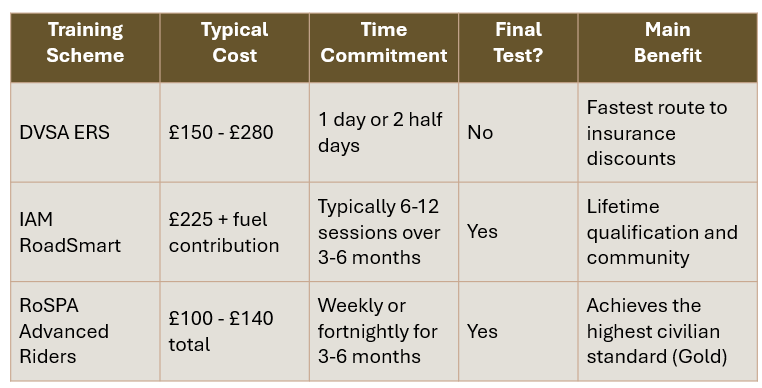
Typical cost: £150 to £280
Time commitment: one full day, or sometimes two half-day sessions but it depends on the rider.
Best for: riders who want fast, professional coaching with minimal fuss.
Reputation - Just a quick assessment
Reality - It's structured coaching with no pass/fail until you're ready.
To find out more about ERS Pros and Cons, what to expect on the day and feedback from previous participants read our in depth guide: The DVSA Enhanced Rider Scheme
IAM RoadSmart
IAM RoadSmart is one of the best-known advanced rider training routes in the UK. It is usually delivered through local volunteer groups, where trained observers mentor you through a series of observed rides before you take the final test.
Typical cost: around £225, plus possible local fuel contributions
Time commitment: around 6 to 12 sessions over 3 to 6 months
Best for: riders who want recognised training plus a supportive local riding network.
Reputation - Rigid. Full of ex-police riders. Everyone rides the same way.
Reality - IAM still teaches Roadcraft, but modern coaching focuses on understanding why decisions are made rather than blindly following a formula. Experiences vary considerably between local groups and individual Observers.
To explore IAM RoadSmart, what it is and why it might be right for you read our in depth guide: IAM RoadSmart Advanced Rider Training: Is It Right for You?
RoSPA Advanced Riders
RoSPA Advanced Riders follows a similar volunteer-supported model, but with a stricter grading system rooted in the Roadcraft approach. Instead of simply pass or fail, riders are graded Bronze, Silver or Gold, with RoSPA Gold widely seen as one of the highest levels of civilian road-riding recognition in the UK.
Typical cost: test fee plus local group fee and fuel contribution
Time commitment: usually several months of regular runs and coaching
Best for: riders who want the most rigorous road-based route and are happy with periodic re-testing.
Reputation - Gold is the pinnacle of civilian riding.
Reality - Gold is undoubtedly one of the most respected achievements in UK motorcycling. That reputation is built on decades of history, a graded system and three-yearly reassessments. Whether it represents a fundamentally higher riding standard than other advanced qualifications is less clear-cut, with experienced riders involved in both organisations often pointing to the shared Roadcraft principles underpinning each scheme.
For more information read our article on what to expect and what is different about the RoSPA Advanced Riders training
Specialist motorcycle training as an alternative or addition to accredited road schemes
Not all rider development is about roadcraft certificates. If your goal is sharper technical skill, greater confidence in a specific environment, or a better understanding of what the bike can do, specialist motorcycle training has plenty to offer.
Track training
Track-based coaching is the safest place to explore braking, cornering, body position and lines without potholes, diesel spills, tractors or oncoming traffic joining the conversation. It can transform confidence in bends and teach you how to use vision, throttle and braking with much more precision.
Ready to take to the track? Read Tracy's review
Off-road and adventure training
Loose surfaces teach lessons tarmac does not. Off-road and adventure bike training improve traction awareness, balance, body position and calmness when the bike starts moving underneath you. That confidence is hugely valuable even if your “adventure” is mostly a gravel car park and the occasional muddy lane.
Is there a dream adventure trip in your future, or do you want more confidence to tackle any surface? Read Off-Road & Adventure Bike Training Explained next month
Machine control and extreme handling
From gymkhana-style low-speed precision to more specialist coaching on advanced handling, these courses focus on pure bike control. They can make filtering, U-turns, heavier bikes and awkward real-world manoeuvres feel much less dramatic.
There are every flavour of courses out there, but if you want some insight into these read: Motorcycle Machine Control Courses Explained next month
Passing your test teaches you how to ride. Advanced motorcycle training teaches you how to ride well.
Whether you choose DVSA ERS, IAM RoadSmart, RoSPA or a specialist skills school, the right training can make every ride smoother, safer and more enjoyable. The best route is the one that fits your riding goals, your budget and the kind of motorcyclist you want to become.
Some riders want a one-day, focused course that gets straight to the point. Others prefer a slower build over several weeks or months, with repeated observed rides and time to let new habits bed in. Neither approach is automatically better. It depends on your budget, schedule and how you learn best.
Tell us what you think about Advanced Training in our August Poll